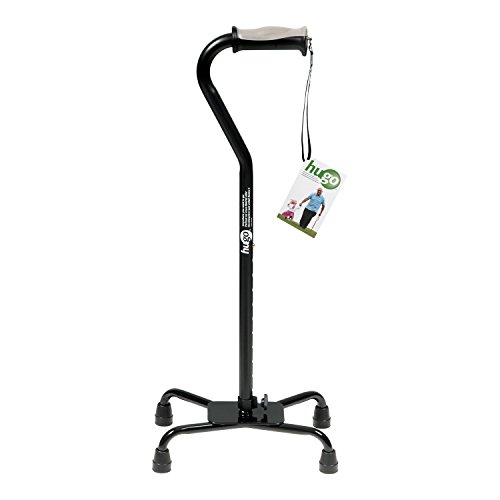

Yes, Medicare Advantage covers canes as Durable Medical Equipment (DME) when your doctor recommends one for balance or mobility. This includes standard single-tip canes, quad canes with a four-legged base, and folding canes. The process is simple: your doctor notes the need, you call your plan to find a supplier, and the supplier provides the cane, usually at no cost to you.
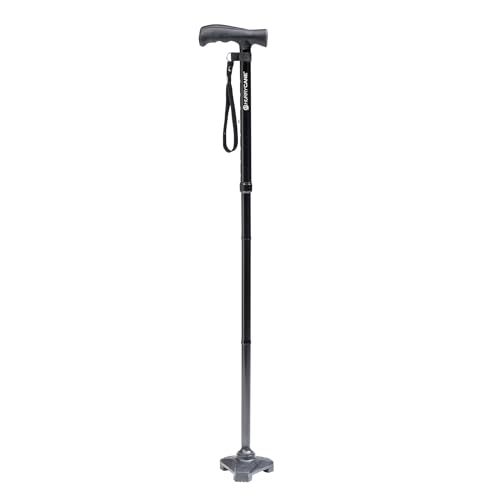
HurryCane Folding Cane
$30-50 · Covered under Medicare Advantage DME benefit
What Types of Canes Does Medicare Advantage Cover?
Medicare Advantage plans cover several types of canes under the DME benefit. The right type depends on how much support you need and your specific medical situation.
- Standard cane: A single-tip cane with a curved or T-shaped handle. This is the most basic option, designed for people who need mild balance assistance or slight weight-bearing support on one side.
- Quad cane: A cane with a four-legged base instead of a single tip. The wider base provides significantly more lateral stability and can stand on its own. This is the right choice when balance deficits are more significant.
- Folding cane: A cane that collapses into sections for easy storage or travel. Good for people who are relatively mobile but want a cane available for uneven terrain, longer walks, or situations where fatigue sets in.
Which Type of Cane Is Right for You?
Your doctor or physical therapist is the best person to guide this decision, but here is a general framework to help you understand the options before your appointment.
Standard canes work well for mild balance issues, minor joint pain, or when you need occasional support rather than constant reliance on the cane. They are lighter and easier to use on stairs.
Quad canes are recommended for people with more significant balance problems. Common situations include recovery from a stroke (where one side of the body is weaker than the other), hip or knee replacement recovery with significant weakness, or any condition causing notable instability during walking. The four-point base distributes weight better and gives a much more stable platform than a single tip.
Folding canes are often chosen by people who are active and independent most of the time but want a compact option to carry in a bag or keep in a car. They are not designed for heavy reliance but are useful for those who need occasional assistance.
How Does the Medicare Advantage Coverage Process Work?
Cane coverage through Medicare Advantage is one of the simpler DME benefits to navigate. Here is what to expect:
- Talk to your doctor. At your next appointment, mention your balance or mobility concerns. Your doctor will note the need for a cane in your medical record. In many cases, this note in your chart is sufficient without a separate formal prescription document.
- Call Member Services. Use the phone number on the back of your Medicare Advantage card. Ask specifically: "Is a cane covered under my DME benefit, and do I need prior authorization?" Most plans cover canes without requiring prior authorization.
- Find an in-network supplier. Your plan will give you a list of approved DME suppliers in your area. You can call one of these suppliers and let them know your doctor has documented a need for a cane. They will handle the billing with your plan.
- Receive your cane. The supplier either mails the cane to you or, in some cases, has it available for pickup. Most members receive a covered cane at no out-of-pocket cost after the plan's standard cost-sharing is applied.
What If I Want a Specific Style Not Offered by the Supplier?
In-network DME suppliers carry standard models that meet Medicare coverage requirements. If you want a specific color, a particular handle design, or a style that the in-network supplier does not carry, you have a couple of options.
First, ask your plan whether it offers any allowance toward retail purchases. Some Medicare Advantage plans allow you to purchase a preferred item out of pocket and receive a partial reimbursement up to the amount the plan would have paid for the covered model.
Second, you can simply purchase the style you prefer at retail and use the covered cane for everyday purposes. The retail price for most canes is modest, ranging from $15 to $60 depending on the type and features.
When Is a Cane Not Enough?
A cane is the right tool when you need some balance support but can walk independently with minor assistance. If your balance problems are more severe, if you tend to fatigue quickly, or if you need support on both sides of your body, a rollator walker may be a better fit. Rollators are also covered under Medicare Advantage DME and offer four-wheeled support along with a built-in seat for rest stops.
Your physical therapist is the best person to evaluate which mobility aid matches your current functional level. A PT evaluation is often covered by Medicare Advantage as well, and the resulting recommendation carries significant weight with your plan when requesting DME coverage.
Safety Tips for Using a Cane Correctly
Using a cane correctly is just as important as having the right type. A few key points:
- Hold the cane on your stronger side, not the side with the injury or weakness. This is counterintuitive for many people but is the biomechanically correct technique.
- Adjust the cane height so your elbow is bent at a comfortable, slight angle (about 15 to 20 degrees) when the tip is on the ground. A cane that is too short or too tall creates strain and reduces stability.
- Move the cane forward at the same time as your weaker leg, so the cane and the weak leg move together as a pair.
- Replace the rubber tip when it shows signs of wear. A worn tip can slip on smooth floors and is a fall risk.
- Ask your physical therapist for a brief gait training session if you are new to using a cane. Proper technique makes a significant difference in both safety and comfort.
Official Medicare Resources