

Yes, Medicare Advantage covers bedside commodes as standard Durable Medical Equipment (DME) when prescribed by a doctor. A bedside commode is one of the most commonly ordered items at hospital discharge, and most Medicare Advantage members receive it at little or no out-of-pocket cost. The key step is getting a written order from your doctor or hospital discharge team before you leave the facility.
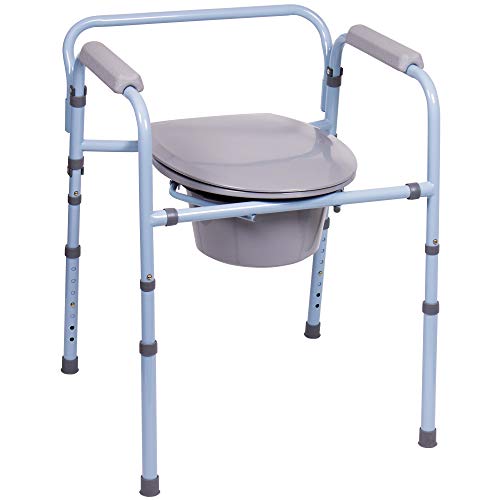
Carex Folding Commode
$40-70 · Covered under Medicare Advantage DME benefit with doctor's order
What Is a Bedside Commode?
A bedside commode is a portable toilet chair. It looks like a sturdy chair with a bucket or collection container beneath the seat. It can be placed right next to the bed for use during the night or when walking to the bathroom is not safe. Many commodes are also designed to fit directly over a standard toilet, functioning as a raised toilet seat with arms when the bucket is removed.
This dual function makes a bedside commode one of the most versatile pieces of recovery equipment available. A single item can serve as a nighttime toilet, a raised toilet seat, and a chair with armrests for toileting support.
Who Typically Needs a Bedside Commode?
Bedside commodes are most commonly needed in these situations:
- After surgery: Hip replacement, knee replacement, abdominal surgery, and cardiac procedures all leave patients too weak or restricted to safely walk to the bathroom, especially at night.
- After hospitalization for illness: Extended stays for pneumonia, heart failure, stroke, or other serious conditions cause significant muscle loss. The bathroom can feel very far away during early home recovery.
- Fall risk at night: Many falls happen when a person gets up in the dark to use the bathroom. A bedside commode eliminates the need for that nighttime walk entirely.
- Severe mobility limitations: People with advanced arthritis, Parkinson's disease, or significant weakness may need a commode as a permanent fixture rather than a temporary recovery tool.
How to Get a Bedside Commode Covered Through Medicare Advantage
The process is straightforward and usually moves quickly, especially when coordinated through a hospital discharge.
- Get a doctor's order. Ask your doctor, surgeon, or the hospital discharge planner to write an order for a bedside commode. The order should note the diagnosis and why the item is medically necessary. At most hospitals, discharge planners handle this automatically as part of the discharge process.
- Confirm your plan's DME coverage. Call the Member Services number on the back of your Medicare Advantage card and confirm that bedside commodes are covered under your DME benefit. Ask about any prior authorization requirements.
- Contact an in-network DME supplier. Your plan will provide a list of approved suppliers in your area. The supplier contacts your doctor's office to verify the order and then schedules delivery.
- Arrange delivery timing. When a commode is ordered at hospital discharge, delivery is often same-day or next-day to ensure the item is in your home when you arrive. Coordinate the timing with your discharge planner.
Types of Commodes: Which Is Best?
Not all commodes are the same, and knowing the types can help you ask for the right one.
- Standard commode: Fixed arms, four legs, bucket underneath. Simple and reliable.
- Drop-arm commode: The arms swing down or away to the side, making it much easier to transfer onto the seat from a wheelchair or bed without having to step over a fixed arm. This is the preferred type for anyone who uses a wheelchair or has limited standing ability.
- Folding commode: Collapses flat for storage or travel. Useful if you will be traveling during recovery or have limited space.
- 3-in-1 commode: Functions as a freestanding commode, a raised toilet seat (placed over the toilet), and sometimes a shower chair. This is the most versatile option and is frequently covered by Medicare Advantage DME.
Ask your doctor or DME supplier specifically for a drop-arm or 3-in-1 commode if either of those features would benefit you. Suppliers typically carry multiple models and can accommodate specific needs when there is a documented reason.
Does a Bedside Commode Also Work as a Raised Toilet Seat?
Yes, most 3-in-1 commodes can be placed directly over a standard toilet with the bucket removed. The seat height is elevated compared to a standard toilet, and the arms provide support for sitting down and standing up. This is a significant benefit for people recovering from hip or knee surgery, where sitting onto a low surface is restricted.
If you need both a bedside commode and a raised toilet seat, ask your doctor or discharge planner about a 3-in-1 model. Getting one item that serves both purposes simplifies the DME order and may be easier to coordinate.
What Does It Cost?
Under the Medicare Advantage DME benefit, a bedside commode is typically covered at little or no cost to you after meeting your plan's deductible and cost-sharing requirements. Many members receive commodes at no out-of-pocket expense, particularly when the item is ordered at hospital discharge when medical necessity is well-documented. If you are comparing costs before going through insurance, standard commodes generally retail for $40 to $100, with 3-in-1 drop-arm models at the higher end of that range.
Tips for Using a Bedside Commode Safely
Once your commode is delivered, a few setup steps make it safer and more comfortable:
- Place the commode on a non-slip surface or ask for non-slip feet if the floor is slippery.
- Position it so the stronger or less-affected side of your body is closest to the bed for easier transfers.
- Make sure the seat height is adjusted so your feet are flat on the floor and your knees are at or slightly below hip level.
- Keep a small night light nearby so you can see the commode clearly if you need it in the dark.
Official Medicare Resources
